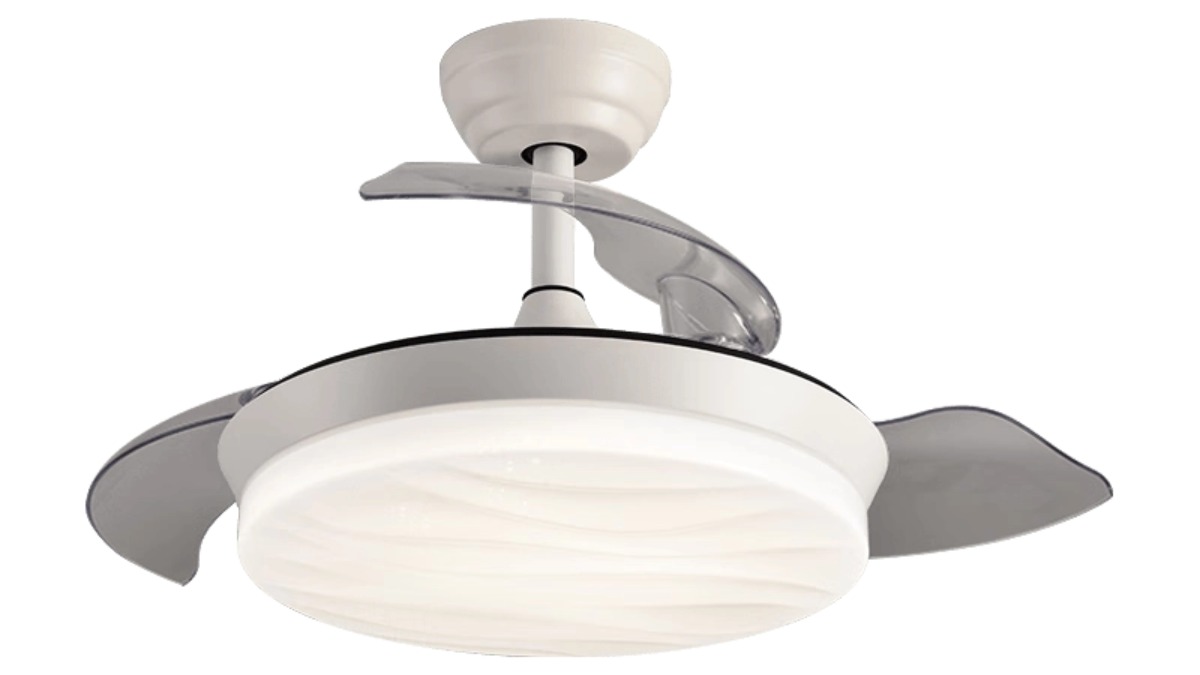
Ceiling fan lights combine lighting and air circulation functions. In recent years, they have gained strong demand across the European market amid frequent extreme heatwaves and rising energy costs. However, this composite product faces a more complex energy efficiency regulatory framework than ordinary luminaires when entering the EU market.
Since 2021, the EU has phased out the old A+++ rating system and adopted the 7-tier A–G energy label, significantly raising market access thresholds. For exporters of ceiling fan lights, ErP compliance has become a basic prerequisite for accessing the EU market. Products without completed EPREL database registration or mismatched label information risk direct customs detention or delisting from e-commerce platforms.
01 Why Ceiling Fan Lights Require "Dual Compliance"
The first key to understanding ErP certification for ceiling fan lights is clarifying their legal classification.
The ErP Directive (Ecodesign Directive for Energy-related Products, Regulation No. 2009/125/EC) is a harmonised directive under the CE certification framework, applicable to most mains-powered energy-related products.
Ceiling fan lights with built-in LED light sources qualify as "luminaires containing light sources". They must satisfy the mandatory requirements of energy labelling Regulation (EU) 2019/2015 for the lighting part. Meanwhile, the fan motor falls under ecodesign requirements defined in Regulation (EU) 2019/2020.
This means ceiling fan lights cannot achieve compliance through a single round of testing:
Independent testing for the lighting module and fan module
Separate consolidation of test data
Dual registration within the EPREL database
Display of two sets of parameters on the energy label
Common Misconception: Many manufacturers believe compliance of the lighting section alone is sufficient. In reality, standby power consumption of the fan motor and potential impacts of overall thermal dissipation on light source lifespan are both subject to assessment.
02 Core Parameters for the Lighting Module
Under Regulation (EU) 2019/2015, the lighting portion of ceiling fan lights must meet the following key parameters:
Luminous Efficacy
From 2026, the threshold for Class A energy efficiency rises above 210 lm/W, while the minimum market-entry luminous efficacy requirement has also increased substantially.
Colour Rendering Index (CRI)
Typically ≥80.
Flicker Testing
New regulations mandate testing of two metrics:
Many legacy test reports only record SVM without PstLM data, which will be rejected directly during EPREL review. This is a frequent cause of hold-ups for luminaire exports to Europe.
Lumen Maintenance & Durability
A 3600-hour durability test is required to verify compliance of luminous flux maintenance.
03 Fan Module: Standby Power Consumption as the Core Focus
The fan module of a ceiling fan light is not directly graded under the A–G energy rating system, yet its power performance affects overall product compliance:
Standby / Off-mode Power
≤0.5W. This item has become a top priority in audits starting from 2025.
Networked Standby Power
For smart models with Wi-Fi or Bluetooth controls, the limit for networked standby power is tightened to ≤2.0W.
Fan Energy Efficiency Ratio (EER) & Airflow
Efficiency rating and testing shall be performed according to fan type (axial / centrifugal).
Regulatory Update: The EU published the new fan ecodesign Regulation (EU) 2024/1834 in 2024, imposing stricter system-level efficiency requirements for fans with input power from 125W up to 500kW, effective from 24 July 2026. According to Eurovent industry FAQs, comfort ceiling fans are currently outside the scope of this regulation. Manufacturers of ceiling fan lights should closely track future revisions.
04 Certification Process: 5-Step Workflow
Step 1: Product Classification & Standard Confirmation
Confirm applicable ErP directives and test standards, verify whether the product is classified as a luminaire with integrated light sources, to avoid registration failure caused by misclassification.
Step 2: Commission Laboratory Testing
Submit samples to a CNAS or EU-recognised laboratory. Normally 8–10 units are required for ceiling fan lights; the durability test for light sources consumes a larger quantity of samples.
Test items include: photometric & electrical parameters, energy efficiency index, standby power, flicker and durability.
Step 3: EPREL Database Registration
Non-EU manufacturers cannot register EPREL accounts independently. An EU Authorised Representative (EUAR) is mandatory to submit test reports, Declaration of Conformity (DoC) and product data via an EU Login corporate account.
Upon approval, a unique energy label and traceable QR code will be generated.
Important reminder: Ensure registered data matches mass-produced products before submission. Registration will become invalid if, for example, a 220V version is registered while 110V units are shipped, or if critical components are modified during mass production.
Step 4: Energy Label Creation & Affixing
The energy label must contain:
Supplier name and product model
A–G energy efficiency class
Energy consumption data under standard operating conditions
EPREL QR code and relevant regulation reference
Minimum standard size: 36mm × 72mm. A simplified 20mm × 54mm version is permitted for compact products. The label shall be affixed to product packaging and user manuals.
Step 5: Retention of Technical Documentation
The full technical file must be kept for at least 10 years for inspection, which is the primary document set for market surveillance audits.
05 Document Checklist: Full Technical File Contents
Basic Product Information
Technical Design Documentation
Schematic circuit diagrams
PCB layout drawings
Bill of critical components (brand and specifications of LED sources, LED drivers, control modules)
Test Reports
Full energy efficiency test reports issued by an ISO 17025 or CNAS accredited laboratory.
Covering luminous efficacy, spectrum, electrical parameters, standby power, flicker and durability data.
Energy Efficiency Calculation Records
Detailed calculation trails deriving the A–G efficiency class from test results.
Declaration of Conformity (DoC)
Signed by the manufacturer to accept full compliance liability.
EU Authorised Representative Information
Non-EU enterprises must appoint an EUAR and bind this representative information during EPREL registration.
06 Our Services
As a professional third-party testing and certification body, we provide the following services for ceiling fan light ErP certification for the EU market:
Accreditation: CNAS/CMA accredited laboratory, reports recognised by EU market surveillance authorities
Full-scope testing: luminous efficacy, CRI, flicker (SVM+PstLM), durability, standby power, fan efficiency and more
End-to-end service: product classification, sample testing, technical file compilation, EUAR coordination, EPREL registration and label generation in one package
New regulation support: familiar with (EU) 2024/1834 and latest regulatory updates, advance compliance risk assessment available
Multi-region energy efficiency coverage: we also offer US DOE, California CEC and UK energy certification services