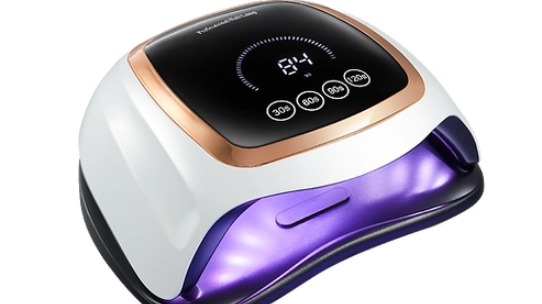
UV nail lamps are essential equipment in nail salons and home nail care applications. They utilize UVA ultraviolet radiation to rapidly cure gel nail polish. However, these devices operate in close proximity to users’ hands, and their photoradiation safety is far more complex than it appears. Test results released by the Shanghai Consumer Council show that some nail lamps can reach Risk Group 3 (high risk) in terms of hazards to human skin and eyes during operation.
IEC 62471 photobiological safety testing has become a mandatory technical threshold for domestic sales, export certification and e-commerce platform access for nail lamp products.
1. Standard Position & Risk Classification for Nail Lamps
IEC 62471, Photobiological safety of lamps and lamp systems, published by the International Electrotechnical Commission, covers wavelengths ranging from 200 nm to 3000 nm. It specifies exposure limits for optical radiation hazards, measurement techniques and classification schemes. Its EU counterpart is EN 62471, while the corresponding Chinese national standard is GB/T 20145; all three share consistent technical requirements.
IEC 62471-6 provides a more targeted assessment framework for ultraviolet lamp products, applicable to lamp products where over half of radiant power falls within the 180 nm–400 nm ultraviolet band, including cosmetic devices. Nail lamps mainly rely on 340–405 nm UVA radiation to cure gel polish. Most mainstream models have power ratings between 48 W and 168 W; higher power generally corresponds to stronger UVA irradiance.
Based on test results, products are categorized into four risk groups:
RG0 (Exempt Group): No hazard; protective measures are not required. Due to UV emission, nail lamps rarely achieve this grade.
RG1 (Low-Risk Group): Negligible risk under normal use. This is the mainstream compliance target and the recommended risk class for nail lamps.
RG2 (Moderate-Risk Group): Requires controlled usage duration and clear warning markings.
RG3 (High-Risk Group): Significant safety hazards. Products in this category normally cannot obtain market access in the EU.
2. Core Test Items
Photobiological safety testing for nail lamps is not a simple power measurement, but a systematic multi-band evaluation:
Photochemical UV hazard assessment: Evaluates skin and corneal damage risks from 200–400 nm ultraviolet radiation, verifying compliance with the 8-hour exposure limit (30 J/cm² for UVA band).
UVA-specific hazard assessment: Focuses on the 315–400 nm band, the primary working spectrum of nail lamps. A calibrated spectroradiometer performs multi-point measurements at a standard distance (typically 200 mm) to accurately determine UVA irradiance and radiance.
Retinal blue-light hazard assessment: Some nail lamps emit blue light components. Weighted blue-light radiance is calculated and compared against standard limits.
Retinal thermal hazard & infrared radiation hazard assessment: Evaluates thermal effects of visible and infrared radiation, as well as impacts of 780–3000 nm infrared radiation on the eye lens and skin.
Temperature rise test: Under maximum operating cycles, surface temperature of the equipment shall not exceed 41°C to prevent low-temperature burns.
3. Application Procedure & Required Documentation
The general workflow is as follows:
The enterprise submits product technical specifications (including light source type, wavelength range and power), user manual, appearance and structural drawings to a CNAS/CMA accredited testing laboratory.
Laboratory engineers conduct an initial assessment and define the test plan.
Deliver samples to the darkroom laboratory for full-spectrum testing using a spectroradiometer.
After testing, a test report is issued stating the product risk group (RG0–RG3) and compliance conclusion.
Required materials:2–3 finished production samples, nameplate information (model, power, manufacturer), product specification sheet, draft user manual, and original power adapter.
Testing cycle: Approximately 7 working days for standard testing. The timeline will be extended accordingly if re-testing is needed after product rectification.
4. Guidance on Selecting Testing Laboratories
When selecting a laboratory for IEC 62471 testing of UV nail lamps, consider the following criteria:
Holding both CNAS and CMA accreditation for internationally recognised reports;
Proficiency in IEC 62471 and IEC 62471-6 standards dedicated to UV lamp products;
Full-band spectral radiometry capability for precise UVA hazard evaluation;
One-stop service covering testing and report issuance.
CTNT (Shenzhen Zhongwei Inspection Technology Co., Ltd.) is a professional optical product testing and certification provider in China with outstanding competence in IEC 62471 testing for UV nail lamps. The laboratory holds CNAS and CMA accreditations and can issue test reports in both Chinese and English. Its optical testing centre covers the full spectrum from ultraviolet, visible light to infrared. CTNT is the only domestic laboratory with FDA recognition for laser product standards and deep expertise in international photobiological safety standards (IEC 62471 / EN 62471). With ten years of experience in photobiological safety testing, CTNT provides manufacturers of nail lamps with one-stop services ranging from risk group assessment to compliance rectification.